Published on
Updated on
Story contact: Rachel Becker, CVMMarCom@missouri.edu
Photos by Karen Clifford
For people living with rare genetic disorders, the challenge isn’t just the disease itself. It’s the lack of attention, funding and viable treatment pathways that often accompany conditions affecting small patient populations.
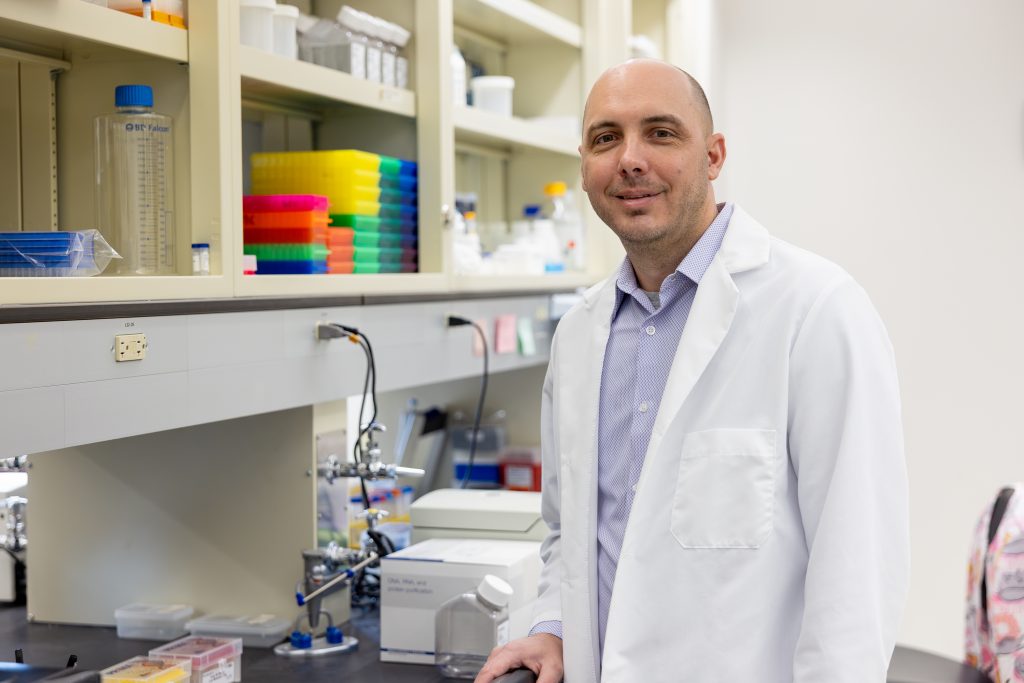
At the University of Missouri College of Veterinary Medicine, Daniel Davis, PhD, is working to change that trajectory.
“People with rare conditions often get left behind because there’s no financial incentive in developing drugs for small populations,” he said. “Being someone who can advocate for them means a lot to me. Even the smallest scientific step forward can impact someone’s life. That’s powerful.”
As an associate research professor in the Department of Pathobiology and Integrative Biomedical Sciences, Davis leads a research program focused on rare neurological and neurodevelopmental disorders. His work centers on understanding how specific genetic mutations disrupt normal biological processes and identifying potential paths toward intervention.
Rare diseases are often understudied, leaving families with limited treatment options and many unanswered questions. By generating custom, humanized cell and animal models that carry specific patient-derived mutations, Davis and his team are able to study disease mechanisms with precision and develop targeted therapies.
“By building accurate disease models and testing therapies that directly correct the underlying mutations, we’re creating a path from discovery to clinical trials that can truly change lives,” Davis said. “Even small advances can make a real difference for patients and families.”
From genetic mechanisms to potential therapies
Davis’ lab develops and studies precisely targeted genetic models to investigate rare disorders of the central and peripheral nervous systems, laying the groundwork for therapies that could one day move from the lab to the clinic. These models allow researchers to examine how individual gene mutations affect development, cellular signaling and neural function — foundational steps toward therapeutic discovery.
“If we can understand what’s going wrong at the molecular level,” Davis said, “we can begin to identify where intervention might be possible.”
One major focus of his work is Baker-Gordon syndrome, a rare condition caused by mutations in the SYT1 gene that affects the central nervous system. His research also includes Charcot-Marie-Tooth disease type 1E, a rare disorder that impacts the peripheral nervous system. Together, these conditions reflect the broader challenges Davis’ lab aims to address across the nervous system.
Because these diseases affect relatively small populations, progress often depends on sustained academic research rather than commercial investment. Davis views this work as a scientific responsibility.
“For patients and their families, this research offers validation that their conditions matter and hope that genetic diagnoses can lead to personalized treatments,” Davis said. “Mizzou’s collaborative environment, especially through the Center for Translational Neurogenetics at NextGen Precision Health, makes that work possible by bringing clinicians and scientists together to move discoveries toward real patient impact.”
Training scientists to think critically and persist
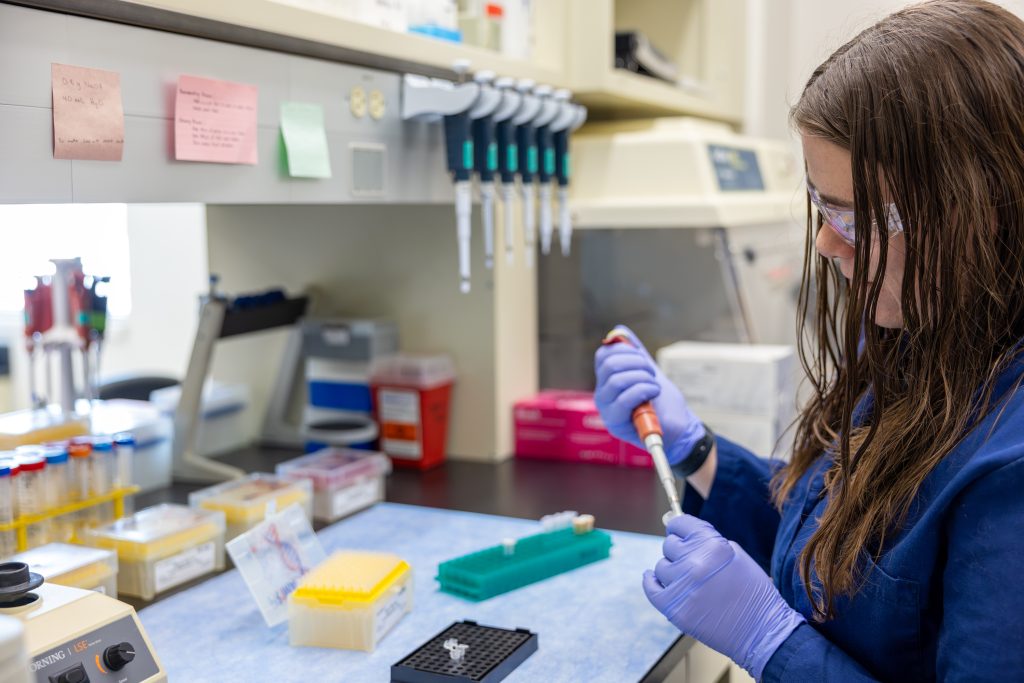
In addition to his research program, Davis is deeply involved in graduate and undergraduate training, bringing the same emphasis on rigor, persistence and problem-solving into the classroom and the lab. He mentors students across disciplines, emphasizing experimental rigor and resilience in the face of setbacks.
“Experiments fail more often than they succeed,” Davis said. “That’s part of the process. The goal is to teach students how to interpret results, adapt and keep moving forward.”
Former and current trainees describe his lab as one that values careful planning, open discussion and collaboration.
Samantha Norris, DVM and Davis’ mentee, said, “I could not ask for a better environment to pursue research than in Dr. Davis’s lab! His experience and creative problem solving when tackling various projects is inspiring. He creates an environment where you can personally feel the positive impact you’re contributing towards individuals, while also enjoying the work itself and the friendly lab atmosphere.”
That balance — pairing scientific rigor with a clear focus on patient impact — reflects the environment Mizzou has intentionally built to advance rare disease research. By investing in collaborative infrastructure, interdisciplinary teams and translational pathways, Mizzou and the College of Veterinary Medicine are ensuring that discoveries made in the lab don’t stop at publication. Instead, they move forward with purpose, bringing visibility, validation and momentum to patients and families whose conditions have too often been overlooked.