Published on
Updated on
Story contact: Rachel Becker, CVMMarCom@missouri.edu
Photos by Karen Clifford
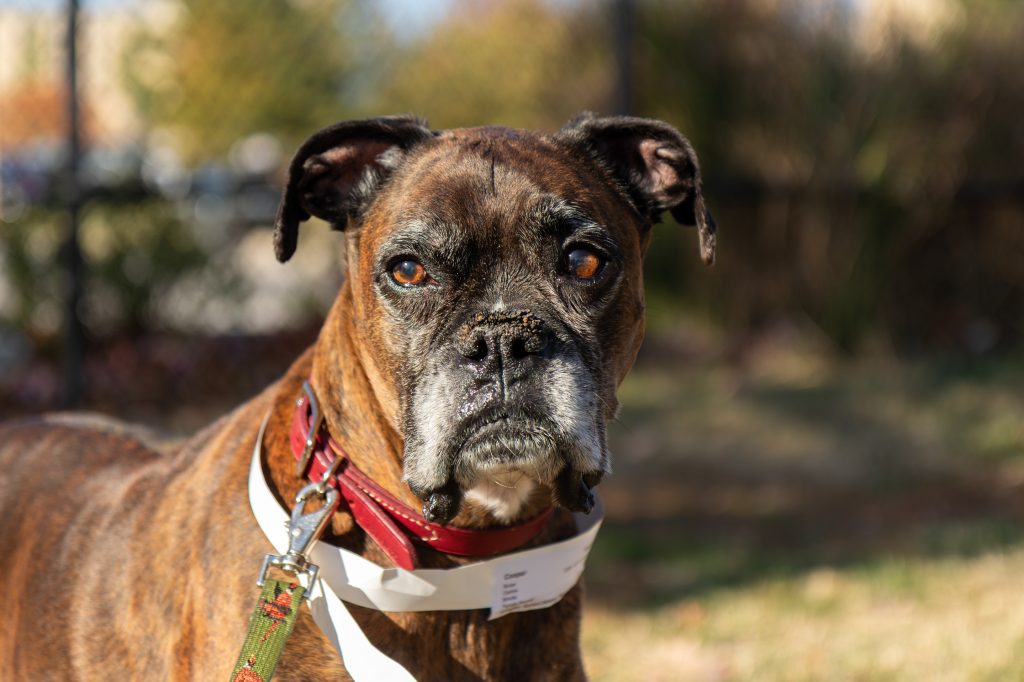
When Cooper’s family walked through the doors of the University of Missouri Veterinary Health Center, they carried the kind of diagnosis a pet owner dreads: an adrenal tumor. But alongside the fear was something else — a small but powerful advantage. The tumor had been found early.
In veterinary oncology, timing can change everything. Early detection can transform a frightening diagnosis into a carefully constructed plan, opening doors to more options, greater precision and, in cases like Cooper’s, advanced surgical techniques that might not be possible later.
“Cooper’s tumor was found early, and that makes a big difference,” said Josie Dornbusch, DVM, MS, DACVS-SA, an assistant teaching professor in small animal surgery. “When we catch these tumors early and small, we have more options on treatments, and a better chance at a longer survival time.”
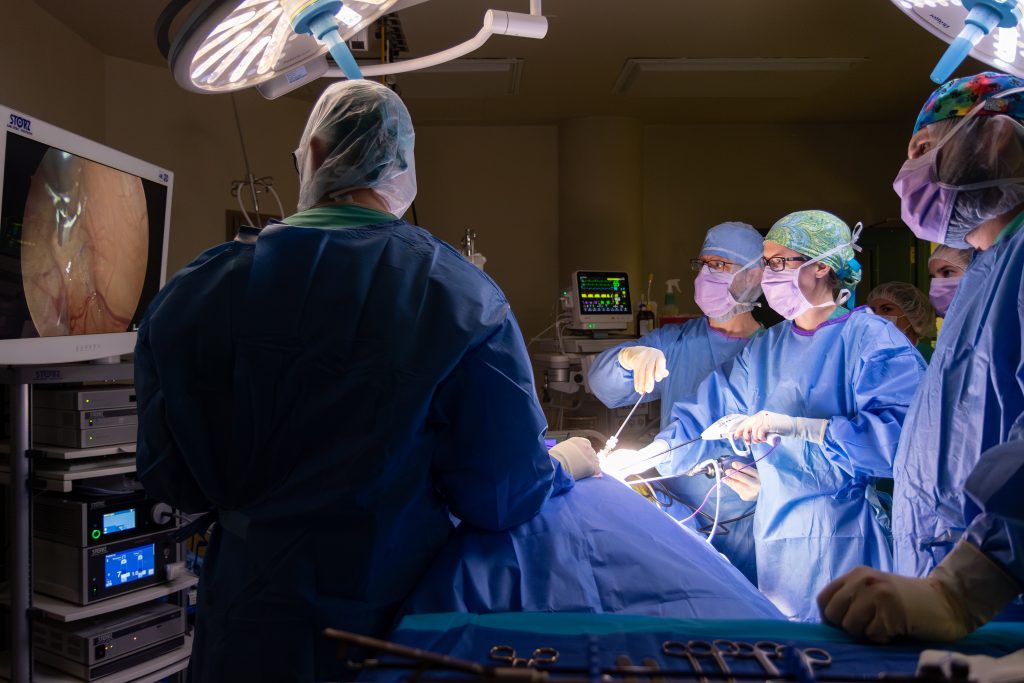
Because of the diagnosis, Cooper’s case could be thoughtfully evaluated by oncology and surgical specialists to determine the best path forward. That evaluation confirmed she was a candidate for a laparoscopic adrenalectomy, a highly specialized, minimally invasive cancer surgery offered at only a few veterinary hospitals in the Midwest, including the Veterinary Health Center.
A common surgery, with a specialized option for the right patients
Minimally invasive surgery offers clear advantages for patients, including smaller incisions, less pain and faster recoveries. For animals like Cooper, that can mean a quicker return to normal life and fewer complications along the way.
At Mizzou, that approach is strengthened by close coordination between surgical oncologists and soft tissue surgeons, allowing teams to tailor treatment plans based on both tumor behavior and surgical feasibility.
“With adrenal tumors, the question isn’t just whether surgery is possible,” Dornbusch said. “It’s whether we can approach it in a way that maximizes safety and long-term outcomes for that individual patient.”
Adrenalectomies are a routine part of the VHC’s surgical oncology caseload, but the laparoscopic approach Cooper received is reserved for a smaller group of patients.
“The minimally invasive option depends on several factors,” Dornbusch said. “Tumor size, location and whether there’s involvement of surrounding structures all matter. Patient size matters too. When everything aligns, we’re able to offer a technique that can significantly reduce post-operative pain and recovery time.”
Only a small percentage of adrenal tumor patients qualify for this approach, but when they do, the impact can be substantial.
“It’s not the right treatment for every dog,” Dornbusch said. “But for the patients who meet the criteria, it can be a game-changer. Cooper is a great example of what’s possible when we can use this technique.”
An easier recovery
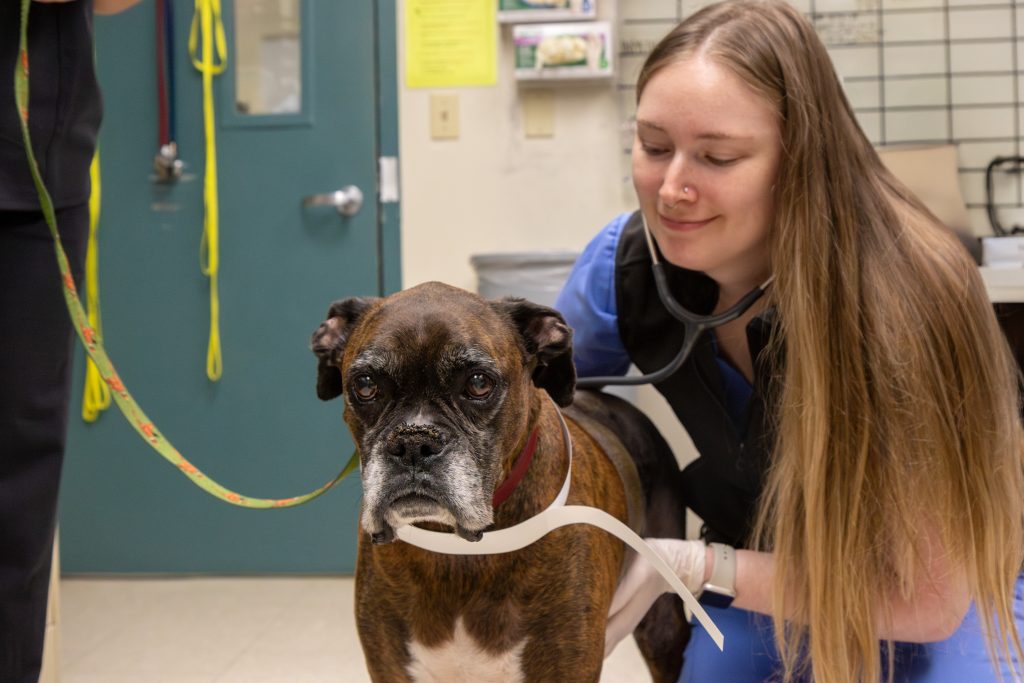
Despite the technical complexity of the procedure, Cooper’s recovery was smooth and swift.
“With the laparoscopic approach, we need very precise control,”said Owen Skinner, BVSc, DECVS, DACVS-SA, MRCVS, an associate professor of small animal surgical oncology. “That level of precision helps minimize trauma and is a big reason patients like Cooper are able to recover so well.”
For Cooper’s family, the difference was evident almost immediately.
“With this procedure, her recovery was easier. She was more comfortable, and we could see her getting back to herself quickly,” said Jim Klingler, Cooper’s owner. “The people at Mizzou saved my dog’s life. I tear up just thinking about. They brought her back to us.”