Published on
Story contact: Nicholas Childress, CVMMarCom@missouri.edu
Photos courtesy Richard and Tanja McCondichie
Richard and Tanja McCondichie have shared their Southern California home with dogs for decades. But their boxer, Malcolm, presented a challenge unlike anything they’d experienced. From an early age, he showed troubling symptoms that would take years to explain.
One of the first things Tanja noticed was how long Malcolm took to recover after exercise. He panted heavily, struggled in the heat and sometimes coughed after activity.
The family sought answers through repeated veterinary visits, extensive testing and evaluations by specialists. Yet despite their efforts, the cause of Malcolm’s symptoms remained elusive.
Then Malcolm developed aspiration pneumonia, requiring three months of antibiotics. Even after treatment, the family was no closer to understanding what was causing his health problems.
During one specialist visit in their home state of California, Tanja asked whether the conditions being investigated would be made worse by exercise, a key detail in Malcolm’s symptoms. When the answer was no, she felt her concerns had once again gone unheard.
“I looked around and said, ‘I feel like nobody’s listening to me,’” Tanja said.
Determined to find answers, Tanja began looking into Malcolm’s symptoms herself. After doing some research, she suspected he might have a sliding hiatal hernia, a condition in which part of the stomach moves through an enlarged opening in the diaphragm and into the chest.
She turned to an online boxer group, where another dog owner pointed her toward the University of Missouri’s Veterinary Health Center (VHC) and BREATHE Clinic.
More than 1,500 miles separated the McCondichies from Mizzou, but the possibility of finally finding answers made the trip worthwhile.
A team ready to listen
From their first phone call to the VHC, the McCondichies sensed something was different.
“When I spoke to the staff on the phone, I finally felt like I was being heard,” Tanja said.
The family came to Mizzou for a comprehensive evaluation through the BREATHE Clinic, the University of Missouri College of Veterinary Medicine’s respiratory and aerodigestive disorders specialty clinic. Aida Vientos-Plotts, DVM, PhD, DACVIM (small animal internal medicine), an assistant professor of small animal internal medicine and co-director of the clinic, met with the family at the start of their visit.
Tanja had read about Vientos-Plotts before the visit but hadn’t expected to meet her right away. Having her involved from the beginning gave the family confidence that Malcolm’s concerns were being taken seriously.
“We were extremely frustrated, but to come to Mizzou and have the staff and doctors treat us and Malcolm so well was a huge relief,” Richard said.
That attention to Malcolm’s symptoms helped the team uncover something previous evaluations had missed. Rather than evaluating his breathing and digestive symptoms separately, Vientos-Plotts suspected the two were connected.
Reflux caused by a hiatal hernia can be difficult to recognize in dogs because they can’t tell us when they’re experiencing symptoms like heartburn. Instead, they might lick their lips, salivate excessively, cough, swallow repeatedly or regurgitate.
Specialized testing at the BREATHE Clinic revealed significant acid reflux, inflammation in Malcolm’s esophagus and irritation in his airways.
With a better understanding of what was happening, the team recommended surgery to repair the hernia. They coordinated with the soft tissue surgery team to schedule the procedure the following week, allowing Malcolm to be treated during the family’s initial trip to Missouri.
A better path forward
Following surgery, Malcolm’s recovery brought encouraging changes. With medication and dietary adjustments to help manage his reflux, he began showing significant improvement. At his four-week follow-up appointment, the McCondichies reported that he had noticeably more energy.
“He’s doing so much better,” Tanja said.
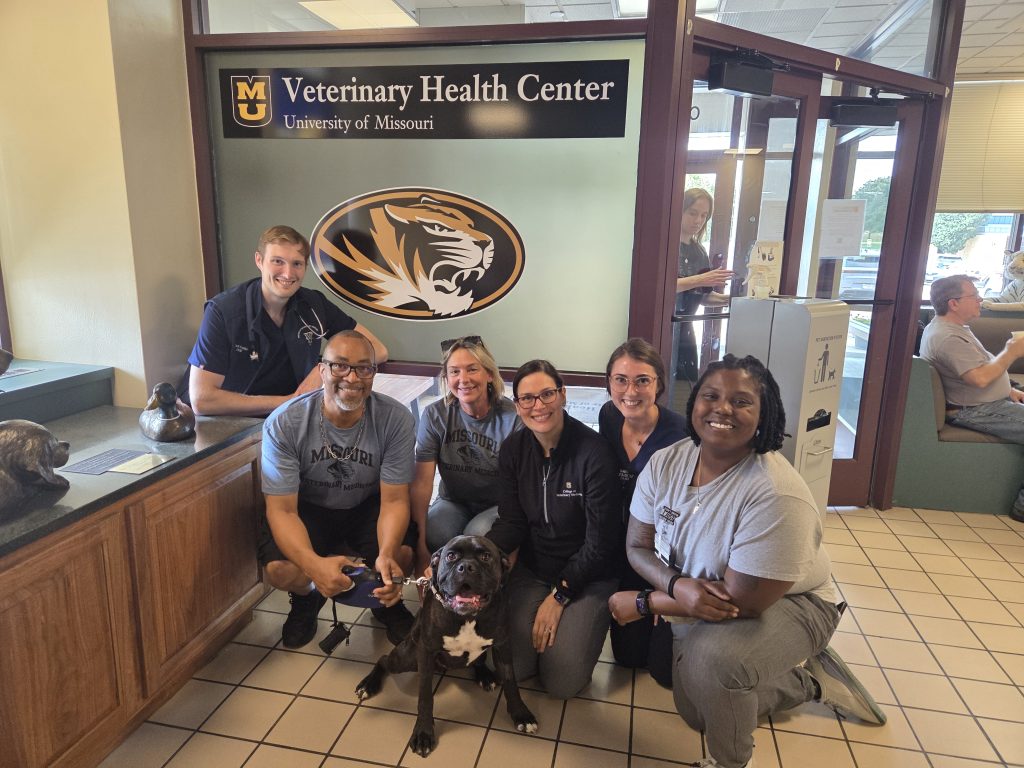
Throughout Malcolm’s care, the McCondichies were struck by the compassion and dedication of the entire VHC team, from specialists and surgeons to technicians and veterinary students.
“The team at Mizzou is incredible,” Tanja said. “I almost cried with relief once I realized we were finally going to get the help Malcolm needed.”
The McCondichies continue to work with the VHC team on Malcolm’s follow-up care. But the greatest reward is seeing the difference in the dog they traveled across the country to help.
At just 4 years old, Malcolm has plenty of life ahead of him. Thanks to his family’s persistence and the specialized, collaborative care they found at Mizzou, he now has a better chance to enjoy those years with the energy and quality of life every dog deserves.