Associate Professor, Director of Graduate Studies (Pathobiology Area)
- BA (English), University of Iowa
- DVM, University of Missouri
- Residency (Lab Animal Medicine), University of Missouri
- PhD (Pathobiology), University of Missouri

Building Address: 4011 Discovery Ridge, MO 65201
Phone Number: 573-882-1019
Email: ericssona@missouri.edu
Lab Website: mumc.missouri.edu
RESEARCH INTERESTS
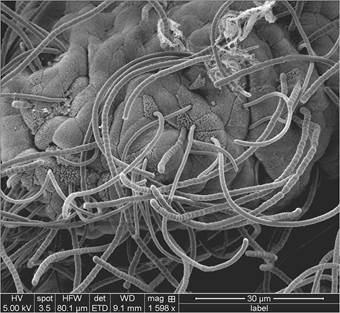
Research in our lab investigates the selective pressures affecting the composition and function of host-associated microbiomes, and the mechanisms by which the microbiome affects host health and disease susceptibility. Current projects in the lab are focused on anxiety-related behavior, feeding behaviors, voluntary physical activity and the fetal programming of those activities in offspring due to features of the parental microbiome pre- and post-fertilization.
Research performed at the Mutant Mouse Resource and Research Center (MMRRC) has identified numerous factors capable of affecting the gut microbiome of research models, developed methods for the experimental manipulation of the microbiome and certain recalcitrant taxa (e.g., segmented filamentous bacteria (Candidatus Savagella), pictured adherent to the ileal mucosa), and evaluated the relevance of various factors (e.g., mouse source, method of GM transfer) on model phenotypes of gastrointestinal, neoplastic, autoimmune and neurodegenerative disease.
An additional branch of research is performed in collaboration with human medical and veterinary clinicians, investigating the microbiomes present in the oral cavity, gastrointestinal tract, respiratory tract and integument of people, cats, dogs, horses, pigs, cattle and various wildlife species. With informed consent, these studies are performed using non-invasive samples or residual material from clinically indicated diagnostic procedures, to identify associations between features of the microbiome and disease across multiple host species. This research, coupled with training in veterinary medicine and traditional laboratory animal microbiomes, provides the foundation for research with an emphasis on comparative microbiology.
TEACHING
V PBIO 4600W/7600 – Host-associated Microbiomes in Health and Disease (course director)
V PBIO 5512 – Veterinary Immunology II (lecturer)
V PBIO 5553 – Veterinary Bacteriology and Mycology (lecturer)
SELECTED PUBLICATIONS
- McAdams, Gustafson, K.L., and A.C. Ericsson. (2026) Biological and technical variation in mouse microbiome analyses and implications for sample size determination. Lab Animal, 55(1): 29-34. PMC12738283
- Gustafson, K.L., Busi, S.B., McAdams, Z.L., McCorkle, R., Khodakivskyi, P., Bivens, N., Davis, D.J., Raju, M., Coghill, L., Goun, E., Wilmes, P., Amos-Landgraf, J., Franklin, C.L., Cortese, R., and A.C. Ericsson. (2025) Fetal programming by the parental microbiome of offspring behavior, and DNA methylation and gene expression within the hippocampus. Microbiome, 13: 254. PMC12699845
- McAdams, Z.L., Campbell, E.J., Dorfmeyer, R.A., Turner, G., Shaffer, S., Ford, T., Lawson, J., Terry, J., Raju, M., Coghill, L., Cresci, L., Lascola, K., Pridgen, T., Blikslager, A., Barrell, E., Banse, H., Paul, L., Gillen, A., Nott, S., VandeCandelaere, M., van Galen, G., Townsend, K.S., Martin, L.M., Johnson, P.J., and A.C. Ericsson. (2025) A novel dataset of 2,362 equine fecal microbiomes from veterinary teaching hospitals across three countries reveals dominant effects of geography and disease. Animal Microbiome, 7:124. PMC12676801
- Presutti, L., Gueningsman, M.C., Fredricksen, B., Taylor, R., Tuckett, A., Folsom, C., Wainwright, R.., Klena, C., Ericsson, A.C., Zapata, I., and A.E. Brooks. (2025) Exploring the interplay between fatigue and the oral microbiome: a longitudinal approach. Microorganisms, 13(12): 2721. PMC12735287
- Ericsson, A.C., McAdams, Z.L., Dorfmeyer, R.A., Hart, M.L., O’Neill-Blair, A., Amos-Landgraf, J., and C.L. Franklin. (2025) Dominant effects of the immediate environment on the gut microbiome of mice used in biomedical research. mSystems, 10(12): e0111225. PMC12710307
- Miller, H.E., Sasser, C.N., Sebastian Hernandez, M., Legako, J.F., Anderson, C.J., Schmitz-Esser, S., Ericsson, A.C., Broadway, P.R., Burdick Sanchez, N.C., Carroll, J.A., Cruz Penn, M.J., and A.L. Petry. (2025) Fiber deprivation and insoluble corn-based fibrous co-products modulate gastrointestinal mucosa-associated microbiota, extracellular matrix remodeling, and intestinal morphology in growing pigs. Journal of Animal Science, 103: skaf360. PMC12613257
- Moraes, J.G.N., Gull, T., Ericsson, A.C., Caldeira, M.O., Evans, T.J., Poock, S.E., and M.C. Lucy. (2025) Evaluating differences in uterine microbiome and inflammatory status at one month postpartum associated with metritis and antibiotic treatment. Journal of Dairy Science, 108(12): 13958-13980. PMID: 40975288
- Ghouri, Y., Ericsson, A.C., Anderson, J., George, J.G., Parks, E.J., and K.O.B. Anguah. (2025) Repopulation of the gut microbiota after a health-screening colonoscopy. PLoS One, 20(9): e0320712. PMC12431200
- Ivanich, K., Yackzan, A.T., Flemister, A., Chang, Y.-H., Xing, X., Chen, A., Yanckello, L.M., Sun, M., Aware, C., Govindarajan, M., Kramer, S., Ericsson, A.C., and A.-L. Lin. (2025) Ketogenic diet modulates gut microbiota-brain metabolite axis in a sex- and genotype-specific manner in APOE4 mice. Journal of Neurochemistry, 169: e70216. PMID: 40890565
- Sieve, A., Giuliano, E.A., McAdams, Z.L., Vientos-Plotts, A.I., Reinero, C.R., and A.C. Ericsson. (2025) Microbiota analysis and standard culture identify bacteria in ophthalmic trypan blue solution commonly used during canine cataract surgery. Veterinary Ophthalmology, doi.org/10.1111/vop.70064. PMID: 40846812
- Porter, M., McAdams, Z.L., Davis, D.J., Townsend, K., Martin, L.M., Wilhite, C., Johnson, P.J., and A.C. Ericsson. (2025) Alterations in the microbiome of horses affected with fecal water syndrome. Veterinary Sciences, 12(8): 724. PMC12390410