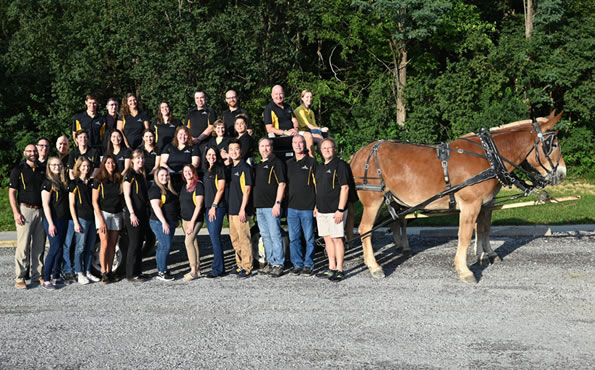
One of the many strengths of the CMP is the sheer number of exceptional trainees. Anywhere from 10-12 veterinarians participate in the program at one time. This allows for mentoring, support and comradery between and amongst trainees who are at varying stages in their training. Trainees bring different experiences, viewpoints, strengths and knowledge to the program which allows for a rich and diverse educational experience.
Abdulhakeem (Bin) Binhambali is originally from Ilorin, a multicultural city in the North-central part of Nigeria, where he will be likened to COMO. He earned his DVM from one of Nigeria’s first-generation Veterinary Schools, Ahmadu Bello University, Zaria, in 2019. Shortly after his graduation, he served his country through National Corp Services in Delta State, Southern Nigeria, where he primarily worked as both a Resident Veterinarian and a COVID-19 frontline professional, and also gained several leadership experiences. Afterward, he worked at his privately established mixed-practice veterinary practice for 2 years before traveling across the Atlantic.
While in the United States, he pursued his longtime passion for becoming a Veterinarian-Scientist by gaining experience at NC State College of Veterinary Medicine, where he worked as a Postdoctoral intern in Translational Research in Pain Lab under the mentorship of Dr. Duncan Lascelles, whom he will forever be grateful to for making his lifelong dream come true. During his time in the lab, he describes his experience as self-reflective and the final motivation to become an expert in Comparative Medicine. The following year, he was matched to a Small Animal Rotating Internship at Tuskegee University, where he also had the opportunity to extern in several Comparative Medicine and Pathology programs, including NC State, Auburn University, UNC Chapel Hill, and the state Diagnostic Laboratories in North Carolina and Alabama.
In 2026, he joined the Comparative Medicine Program at Mizzou as a first-year resident, where he is also expected to pursue his PhD concurrently, with a special interest in Immunology and Cancer Biology, specifically the immunopeptides of colorectal cancer.
Bin is an in-house person who loves spending time with his spouse and kids after work hours. He rarely goes out aside from calls, worship, and playing soccer at the community pitch. He also loves to volunteer for anything that uplifts the face of the community he lives in.
Ashley grew up in a military household and was born in Guam and raised in Europe for 18 years before officially moving back to the United States. Ashley received her bachelor’s degree in animal science at the University of Findlay and completed her DVM at St. George’s University. For clinical year, she attended Virginia-Maryland College of Veterinary Medicine and did the Public Corporate track where she had the opportunity to do 6 months of externships exploring lab animal residency programs. During undergrad, Ashley’s passion for comparative medicine began after joining a research team working on preventing Alzheimer’s disease in people by studying the regenerative properties of zebrafish and researching zoonotic diseases in her writing for sciences class. Continuing her passion for research in vet school, Ashley did a solo retrospective study looking at the prevalence of vector borne diseases in dogs on the island of Grenada over a 10-year span. Her research interests include zoonotic diseases, vector borne diseases, and neurological diseases. In her free time, she enjoys hiking, traveling and golfing.
Meghan Lawlor hails from Saint Louis, Missouri, though Columbia has slowly become her home away from home through the years. Meghan received her bachelor’s degree in biology and her DVM at the University of Missouri. Through undergraduate research experience at several facilities around campus, she was first exposed to laboratory animals. She would go on to conduct a capstone project in the laboratory of Dr. Peter Sutovsky on Huntington’s Disease, later published in the International Journal of Molecular Sciences. During veterinary school, Meghan’s passion for comparative medicine began while enrolled in a didactic laboratory animal medicine class and continued to flourish through her clinical years. She spent eight weeks with the CMP, where she enjoyed participating in clinical care, research and teaching. During residency, she plans to participate in investigator support and the care of biomedical swine. Her research interests include swine models of cardiovascular disease and translational medicine. In her free time, she enjoys hanging out with friends and family, attending spin classes and relaxing with her two cats, Lou and Charlie.
Amy Steeneck grew up in Lehi, Utah, on the lake and in the mountains. She loved research and started a biomedical engineering degree before realizing she didn’t like math as much as chemistry. She graduated with a bachelor’s degree in biochemistry from Utah State University. During her time there, she worked as a husbandry technician for the university research animals and took care of the BSL-3 mice and hamsters. After that, she worked as a veterinary technician for the research animals assisting with procedures and research support for large animals. She found she loved the combination of biosecurity, research and medicine that makes up lab animal programs. Amy then moved to Oregon State University and graduated with her DVM, where, despite her hatred for rain, she grew to love the Pacific Northwest. While there, she was president of the Lab Animal Club, and externed at institutions in each time zone of the U.S. She was accepted to the Mizzou Comparative Medicine Program and has research interests in immunology, virology and bats. Outside of work, she enjoys rock climbing, paddleboarding and gardening with her husband and dog.
Ashley Deviney grew up among the wheat fields of Goddard, Kansas. She always loved animals and graduated with a bachelor’s degree in in fisheries, wildlife, and conservation biology from Kansas State University with the hopes of joining the highly competitive field of zookeeping. During her job search, she found a position as a research technician at a small contract research organization in Kansas City, which introduced her to the world of biomedical research. In this role, she learned valuable skills for working with a variety of research species and conducting preclinical research, and eventually added on the roles of canine colony manager and veterinary technician. Deviney eventually moved to Texas and worked with the preclinical services group at the University of North Texas Health Science Center. There she continued to hone her skills, learned about infectious disease research, and earned her Laboratory Animal Technician certification through AALAS. Following a rodent surgery seminar, Deviney decided she wanted to go back to school to become a lab animal vet. She graduated in 2024 from the University of Illinois College of Veterinary Medicine. During school, she worked in the reproductive toxicology lab of Dr. Jodi Flaws and served two years as the co-president of the Lab Animal Medicine Club. In her free time, Deviney enjoys hiking, drawing, and spending time with her husband, Chance, their hound dog, River, and their two cats Rose and Amelia.
Hannah Weaver grew up about an hour outside of Philadelphia, Pennsylvania, but migrated to Ohio for her undergraduate and veterinary studies. She earned a BS in Biology with a minor in chemistry from Case Western Reserve University and became interested in laboratory animal medicine after interning with their Animal Resource Center and working in an otolaryngology laboratory that used mice and zebrafish models. After university, Hannah attended The Ohio State University College of Veterinary Medicine. During her time there, she served as the president and vice president of OSU’s student ASLAP chapter and did optical coherence tomography imaging research in a surgical oncology laboratory. In addition to her DVM, Hannah graduated OSU with a graduate business minor in health sciences. Hannah’s master’s research explores alternative methods for activating the CreERT system in laboratory rodents. In her free time, Hannah enjoys spending time with her fiancé, Jakob, and true loves, Adam and Lilly the rabbits.
Jessica grew up in both South Carolina and North Carolina. She first became interested in veterinary medicine at 12 years old when her guinea pig, Ginger Snap, became sick and her family took him to the local vet. Jessica earned her B.S. in Biology at Rhodes College in Memphis, TN where she was a fast pitch softball pitcher. At Rhodes College, she was introduced to laboratory animal medicine by being an animal caretaker in the biology facility. She also enjoyed working on a research project with cownose stingrays at the Memphis Zoo during her senior year. Jessica graduated from college in May of 2014 and took a job as a veterinary assistant in a small animal practice in North Carolina. She stayed there for a year before applying to North Carolina State University College of Veterinary medicine and being accepted. During veterinary school, Jessica did a Summer ASLAP fellowship with the University of Missouri, and a summer internship with Yerkes National Primate Research Center. After graduating vet school in May of 2019, she entered the Comparative Medicine Residency at University of Missouri. In her free time, Jessica enjoys hanging out with her young daughter, husband and two dachshunds. Lately, they have been enjoying baking, watching movies, and gardening.
Amy is originally from Imperial, Missouri, which is located just outside of St. Louis. She completed her undergraduate studies at the University of Missouri, St. Louis, where she majored in Biology and minored in chemistry. As her first experience with research, she volunteered in a lab studying gene regulation in filamentous cyanobacteria in the lab of Dr. Teresa Thiel. Amy then moved to Columbia, Missouri, and worked for a year as a Research Specialist at the University of Missouri, Columbia, studying motor neuron degeneration in inducible rodent models of motor neuron death under the mentorship of Dr. Nicole Nichols. Once accepted into veterinary school, she continued her studies in Dr. Nichols’ lab and participated in MU’s Veterinary Research Scholars Program (VRSP) for two consecutive summers. After graduating with her DVM and Phi Zeta Honors in 2023, Amy joined the University of Missouri Comparative Medicine Residency where she is currently a first-year resident. In her free time, Amy enjoys spending time at home with her husband Gary, her Pomeranian, and three cats. She also enjoys taking aerial skills/yoga classes at the local gym, taking care of her house plant collection, and playing video games.
Sam grew up in Frederick, Maryland where she enjoyed many an old bay blue crab. She first became interested in lab animal veterinary medicine in high school while investigating BRCA1 gene mutations in mouse models. She earned a B.A. in Biochemistry from Hood College before entering into the veterinary field as a technician for a general practitioner. After gaining experience in the field, she attended Ross University’s School of Veterinary Medicine. There she served as the University’s ASLAP chapter Vice President and volunteered as a student caretaker for the University vivarium. She completed her clinical year at the University of Missouri and externed in Dr. Aaron Ericsson’s lab studying the differences in ileal gene expression associated with the bile acid metabolites in GM1 and GM4 mice. Sam graduated from Ross with highest honors in January 2023. Afterward, she began work as a general practitioner before joining University of Missouri’s Comparative Medicine Residency Program. Outside of work, Sam enjoys playing soccer and video games, reading a good book, or watching TV and movies. She has two cats, Yam and Moscato. Yam is a calico with a head tilt that was rescued from the streets, and Mo is a shy Tortie who was adopted from the research colony.
Trevor was born and raised in the heart of Silicon Valley – San Jose, California. He earned a B.S. in Zoology from San Francisco State University. While at SFSU, he worked as an undergraduate researcher in an avian parasitology lab and discovered an interest in infectious disease research. However, he wanted to better understand how to lessen the burden of infectious diseases in humans, so he attended UC Berkeley to earn an MPH immediately after graduating from SFSU. He discovered the concept of One Health at UC Berkeley and realized that veterinary medicine and human health are intertwined. That recognition and his interests in zoonoses, antimicrobial resistance, and food safety led him to pursue a DVM at Western University of Health Sciences. He participated in summer research opportunities during his first two years around those interests. However, Trevor realized that laboratory animal medicine met his goals of promoting animal and human health during his third-year lab animal rotation. The year after graduation he spent some time as a general practice relief veterinarian before joining the MU Comparative Medicine Program. In his free time, Trevor enjoys spending time with his wife and son watching TV/movies and playing video games as well as playing table-top board games and fantasy football.